

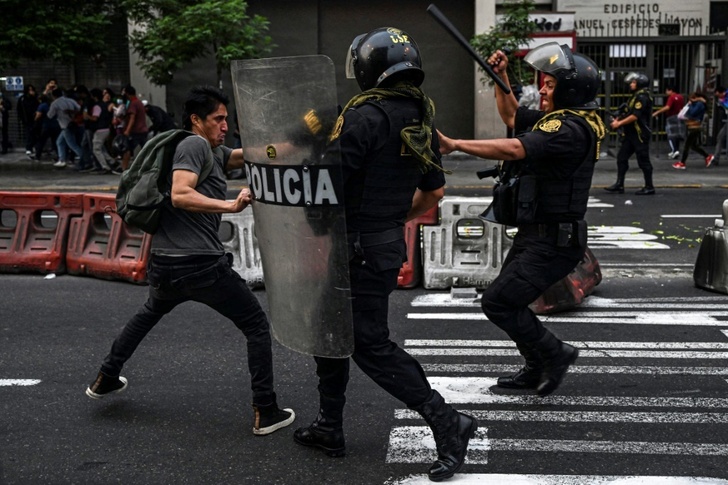
Protests against Peru's new government grew this weekend, with police clashing with angry demonstrators calling for a national strike, fresh elections and the release of detained former president Pedro Castillo.
The protests have swollen steadily since the South American country's legislature on Wednesday threw out the leftist Castillo after he tried to dissolve Congress and rule by decree.
Dina Boluarte, a former prosecutor who had served as Castillo's vice president, was quickly sworn in to replace him.
On Saturday she introduced her new cabinet, a group with an independent and technocratic profile and including eight women.
She named former prosecutor Pedro Angulo as prime minister.
After his impeachment, Castillo was quickly arrested, and on Sunday demonstrators in cities across the country's interior -- including Cajamarca, Arequipa, Huancayo, Cusco and Puno -- demanded his release.

The right-leaning Congress said it would convene in emergency session Sunday afternoon to discuss the crisis.
- 'Indefinite strike' -
Meanwhile, rural unions and organizations representing Indigenous peoples called for an "indefinite strike" beginning Tuesday in support of Castillo, himself the son of a peasant family.

The Rural Front contends that Castillo "did not perpetrate a coup d'etat" on Wednesday when he announced the suspension of Congress and said he would be ruling by decree.
In Lima, the leftist party Free Peru organized a rally Sunday afternoon at the capital's historic Plaza San Martin, the epicenter of the country's political demonstrations.
With his background as a rural teacher and union leader, and with little contact with the nation's elites, Castillo has always drawn his strongest support from Andean regions, while struggling to find backing in coastal Lima.
The ousted president was arrested Wednesday while on his way to the Mexican embassy to seek asylum, and prosecutors have charged him with rebellion and conspiracy.
The demands for new elections come as recent polls show nearly nine in 10 Peruvians disapprove of the nation's legislature.
Political analyst Giovanna Penaflor told AFP that Boluarte -- who on Friday did not rule out calling early elections -- needs to make clear whether she intends to lead a transitional government or to remain in power until 2026.

Peru is now on its sixth president since 2016.
Castillo's 17-month rule was overshadowed by six investigations against him and his family, mass protests demanding his removal, and a power struggle with the opposition-backed Congress.
cm-ljc/bbk/des
© Agence France-Presse
Your content is great. However, if any of the content contained herein violates any rights of yours, including those of copyright, please contact us immediately by e-mail at media[@]kissrpr.com.
Source: Story.KISSPR.com