

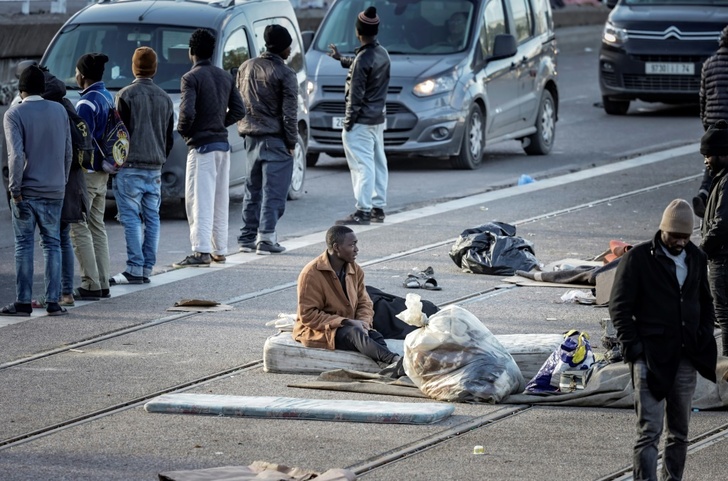
Oumar left home in Guinea five years ago in search of a better life in Europe, but today he inhabits a daily purgatory of hunger, cold and police violence in Morocco.
"Just surviving every day is a battle," said the 25-year-old.
"It's exhausting not eating enough, not sleeping under a roof, not feeling safe, experiencing racism."
He spends his nights camped out on the pavement outside a Casablanca bus station, the makeshift home of hundreds of sub-Saharan Africans whose dreams of reaching Europe are on hold in Morocco.
"We get chased away early in the morning by the police. Then we wander around and come back to the same place at the end of the day," said Oumar.
Like the other migrants interviewed in this report, Oumar's name has been changed.

Oumar sits killing time opposite the Oulad Ziane bus station with a few dozen, mostly Guinean migrants.
Some cook in a makeshift kitchen while others lie exhausted on the pavement.
Someone has hung clothes and blankets on a nearby wall to dry.
Bakary, also from Guinea, said he had been living here for three years.
"This is our sad reality but nobody wants to see it," the 18-year-old said.
The migrants set up this makeshift camp on the edge of the coastal port city of 4.2 million people because of its proximity to the bus station, a major transport hub.
Today, the down-at-heel neighbourhood sees repeated flare-ups with the authorities.

Today, they're back on the same site, divided into groups by country of origin with everyone pitching in to survive.
"Wherever we set up camp, they chase us away," said Boubacar, 27, from Mali. "It's not as if we want to sleep on the tram tracks, but they don't offer us any alternative."
- 'Europe or death' -
Most residents were reluctant to speak to a journalist, but one Moroccan sweets vendor said the migrants were "part of the landscape now, they don't bother anyone".
The station toilets are the only place the migrants have to wash.

Catholic charity Caritas provides migrants with basic medicines and healthcare.
The Moroccan press regularly voices opposition to the migrants.
"End clandestine immigration!" said a recent headline in weekly newspaper Maroc Hebdo, calling it "a social, security and political problem that the state is struggling to manage".
Noureddine Riadi of Morocco's main human rights group, the AMDH, said the migrants were facing "difficult conditions" and called on authorities to do more to help.
"The most vulnerable should be housed in temporary residential centres," he said.
Lamine, a 20-year-old who has tried five times to penetrate the heavily secured Spanish enclave of Melilla on Morocco's northern coast, said he has almost given up.
"We're struggling to keep believing, but my optimism is fading every day," he said.

But it is under growing European pressure to strengthen border controls and restrict the movement of migrants within its territory.
Spanish newspaper El Pais has reported that the EU is considering a 500 million euro grant for Rabat to tackle clandestine migration.
In 2022, Moroccan police detained more than 32,000 migrants and arrested 566 people suspected of involvement in people trafficking, according to official figures.
But migrants in Casablanca say they are not giving up on the dream of reaching Europe.
Bakary said going home would mean "admitting defeat".
"For me, it's Europe or death," he said.
kao-agr/par/kir/aha
© Agence France-Presse
Your content is great. However, if any of the content contained herein violates any rights of yours, including those of copyright, please contact us immediately by e-mail at media[@]kissrpr.com.
Source: Story.KISSPR.com